
Texas Death Records
Texas death records are official vital documents created each time a person dies in the state. The Texas Department of State Health Services Vital Statistics Section maintains certified death certificates going back to 1903. You can request copies from the state office in Austin, order online through Texas.gov or VitalChek, or contact the county clerk where the death occurred. Records from the past 25 years are restricted to immediate family and qualified applicants. After that window, death certificates become open to the public. This guide covers where Texas death records are kept, how to request them, what they cost, and where to find historical records.
Texas Death Records Overview
Where Texas Death Records Are Kept
The Texas Department of State Health Services Vital Statistics Section (DSHS-VSS) is the main state authority for death certificates. The section holds records for every death registered in Texas since 1903. Their office issues certified copies to qualified applicants and keeps the central index used when county-level records are unclear. You can call DSHS Vital Statistics at (888) 963-7111 during normal business hours.
The DSHS Vital Statistics portal is the starting point for most death certificate requests in Texas, covering online ordering, downloadable forms, processing times, and fee information all in one place.
DSHS processes certified death certificate requests for all 254 Texas counties and handles corrections, verifications, and ordering from out-of-state applicants.
At the county level, each of Texas's 254 county clerks holds death records for deaths that occurred within their jurisdiction. County clerks charge $21 for the first certified copy and $4 for each additional copy ordered at the same time. In major cities, a separate health department may hold records for deaths within city limits. Houston deaths go through the Houston Health Department at 8000 North Stadium Drive, Houston, TX 77054. San Antonio keeps records at the City Clerk Vital Records office at 719 South Santa Rosa, San Antonio, TX 78204. Austin deaths from 1957 forward are at the City of Austin Office of Vital Records at 7201 Levander Loop, Austin, TX 78702. Corpus Christi has its own Department of Vital Statistics at 1702 Horne Road, Corpus Christi, TX 78416.
The DSHS death records page explains the full request process, lists who qualifies to order a certificate, and details every method available for submitting your application.
This DSHS page covers in-person, mail, and online ordering in one place, making it easier to pick the right method before you start your request.
Ordering Texas Death Records Online
Two state-approved online services handle Texas death certificate orders. Both send requests directly to DSHS and issue official certified copies.
Texas.gov is the official state eGovernment portal. You fill out an application, verify your identity, and pay with a credit or debit card. Standard online orders take 10 to 15 business days. For Texas residents, you can order records for your immediate family members. Non-residents must be the surviving spouse, a parent, or the funeral director listed on the record. Visit Texas.gov vital records to place an online order.
The Texas.gov online vital records portal accepts credit and debit cards and uses secure electronic identity verification to confirm the applicant's eligibility before processing the request.

Texas.gov orders go directly to the DSHS Vital Statistics office, so there's no third party between you and the official document.
VitalChek is the state's authorized online ordering partner. It has worked with government agencies for over 35 years and processes more than 4 million vital documents per year. VitalChek uses LexisNexis identity verification and PCI-compliant payment security. Orders ship directly from the state agency. Next-day shipping options cost significantly less than standard overnight rates. Go to VitalChek Texas death certificates to order.
VitalChek is the official government-authorized service for ordering certified Texas death certificates online, serving as an exclusive partner with state vital records agencies across the country.

VitalChek processes Texas death certificate orders around the clock and ships certified copies directly from the authorized government source.
Mail and Walk-In Death Record Requests
Mail requests go to DSHS-VSS, P.O. Box 12040, Austin, TX 78711-2040. Use Form VS-142, the Mail Application for Death Record. Include a photocopy of your valid photo ID and a check or money order made out to DSHS - Vital Statistics. Standard mail requests take 6 to 8 weeks after DSHS receives the application. Incomplete applications slow things down.
Expedited mail orders go to a separate address: DSHS-VSS, MC 2096, 1100 W. 49th Street, Austin, TX 78756. Send via overnight mail or USPS Express. The expedited fee is $25 per application. Even with expedited handling, expect 20 to 25 business days. Walk-in service at the Austin office is typically same-day, 30 minutes to 2 hours. The walk-in address is 1100 W. 49th Street, Austin. Hours and directions are on the DSHS website.
County clerks accept in-person and mail requests too. Hours and payment methods vary, so call the specific clerk before you go. Most county offices are open Monday through Friday and handle in-person requests the same day.
Who Can Access Texas Death Records
Texas limits access to death certificates issued within the past 25 years. Under Texas Health and Safety Code Section 191.051, only properly qualified applicants can receive certified copies. For deaths within 25 years, you must be an immediate family member or have documented legal interest in the record.
25 TAC Section 181.1(13) defines immediate family member as the decedent's child, spouse, parent, sibling, or grandparent. If you're not immediate family, you can still request the record by showing a direct, tangible legal interest. An insurance policy naming you as the beneficiary is one example. Attorneys, licensed funeral directors, and government agencies with a legitimate need can also qualify.
The DSHS Acceptable ID page lists every form of identification the state accepts when processing a death certificate request, including driver's licenses, passports, and military IDs.
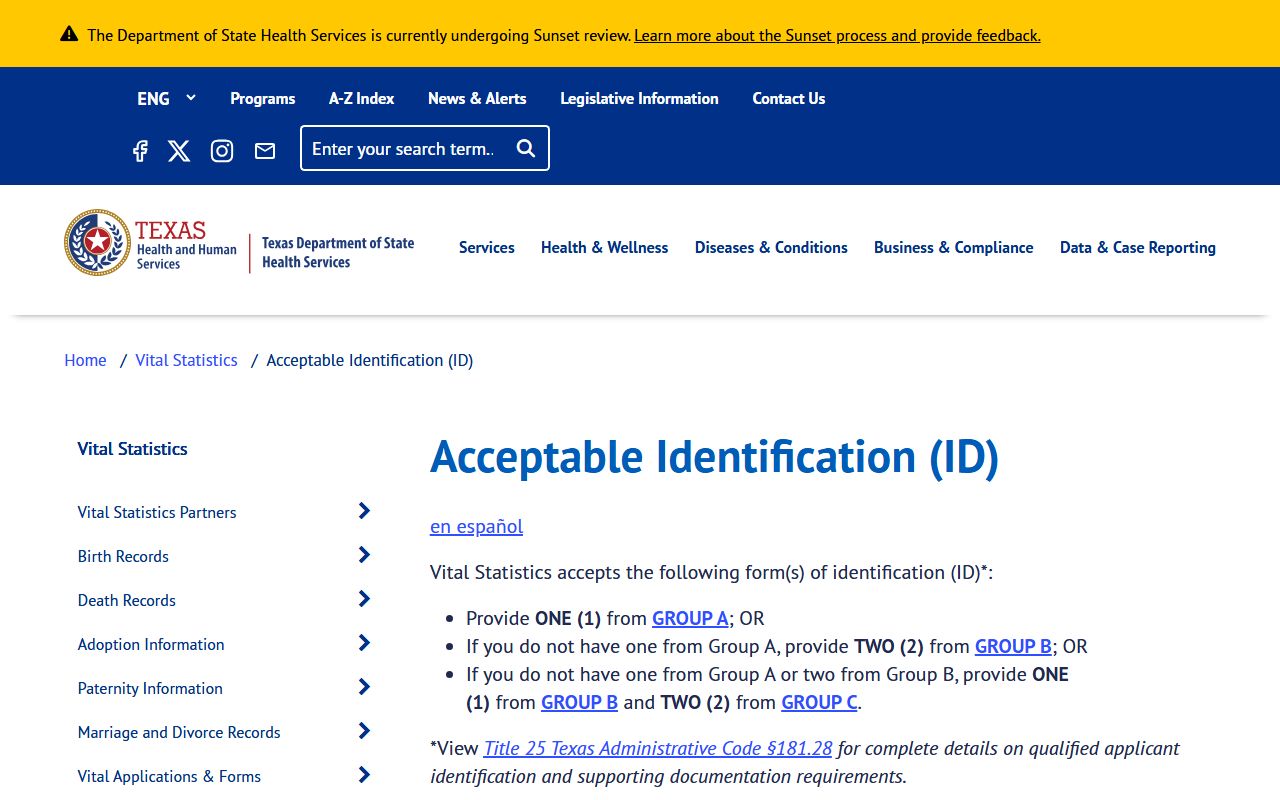
Applications submitted without a valid photo ID will not be processed. Always include a clear photocopy of your government-issued ID with every request.
After 25 years, death records become open to the public. Anyone can request them without stating a reason or proving a relationship. Historical records older than 25 years are also available through genealogical databases. Ancestry.com holds Texas death certificates from 1903 to 1982, and FamilySearch offers multiple free Texas death record collections going back to 1890.
Note: Death certificates from the past 25 years require proof of relationship or a documented legal interest before DSHS or the county clerk will release a certified copy.
Texas Death Certificate Fees
State DSHS fees are $20 for the first certified copy. Each additional copy of the same record ordered at the same time costs $3. County clerk fees are slightly higher: $21 for the first copy and $4 for each additional copy. The county breakdown typically includes a $20 county clerk fee and a $1 vital records archive fee under Texas Health and Safety Code Section 191.0045. Expedited processing adds $25 per application to the state fee, a change that took effect in October 2024 under an update to 25 TAC Chapter 181.
The CDC Texas vital records reference page confirms the state's $20 fee and $3 additional copy fee along with the standard ordering options available to applicants.
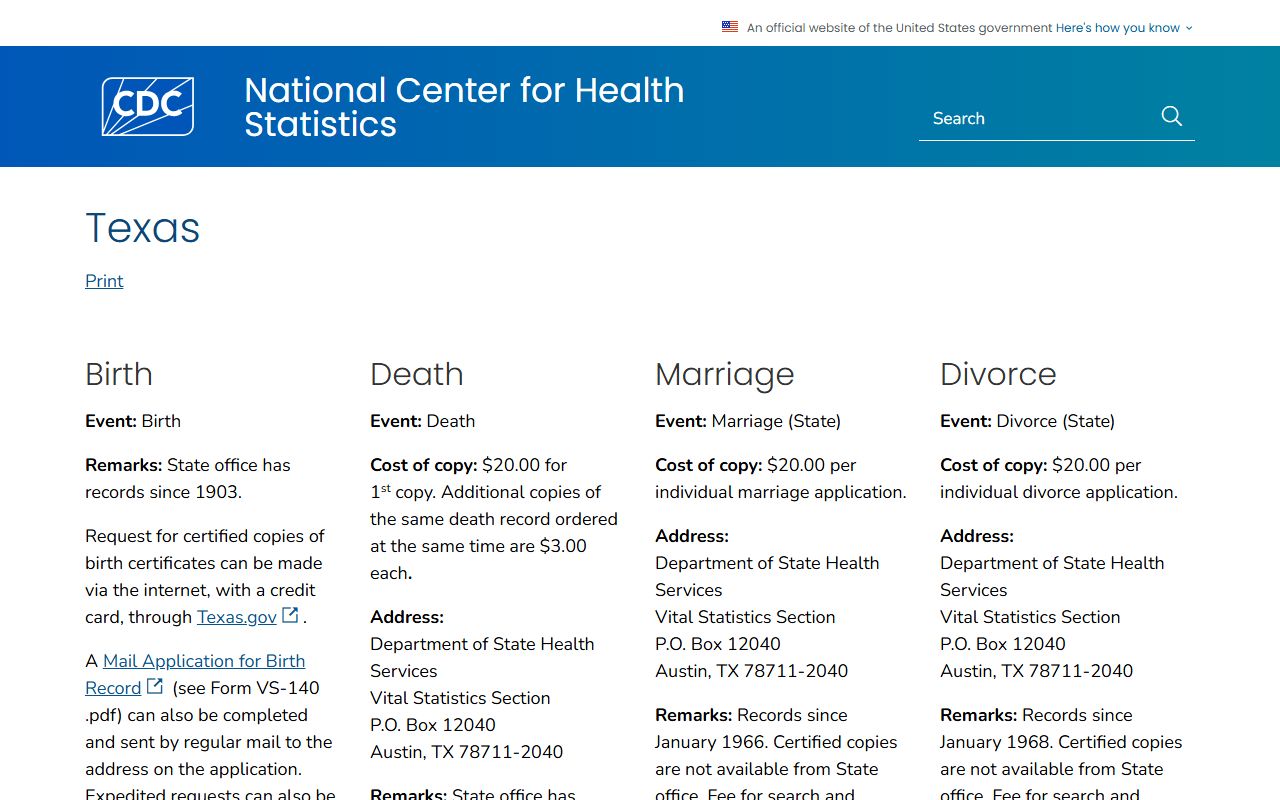
The CDC also confirms that the Texas state office has recorded death records since 1903 and provides the official state mailing address for mail-in requests.
Search fees are non-refundable. If the record isn't found, you get a "not found" letter and the fee is kept. Payment methods differ by how you submit. Online orders take credit or debit cards. Mail requests take check or money order. Walk-in accepts cash, check, money order, and credit cards. County clerks have similar rules but verify with the office before going.
How Texas Death Certificates Are Filed
Every death in Texas is registered through TxEVER, the Texas Electronic Vital Events Registrar. This statewide system connects funeral directors, physicians, medical examiners, justices of the peace, and local registrars in one electronic workflow. Each party completes their section online. No paper changes hands until the final document is printed and certified.
The TxEVER system modernized Texas death registration by replacing paper filing with an electronic process that includes real-time Social Security number verification and digital signatures.
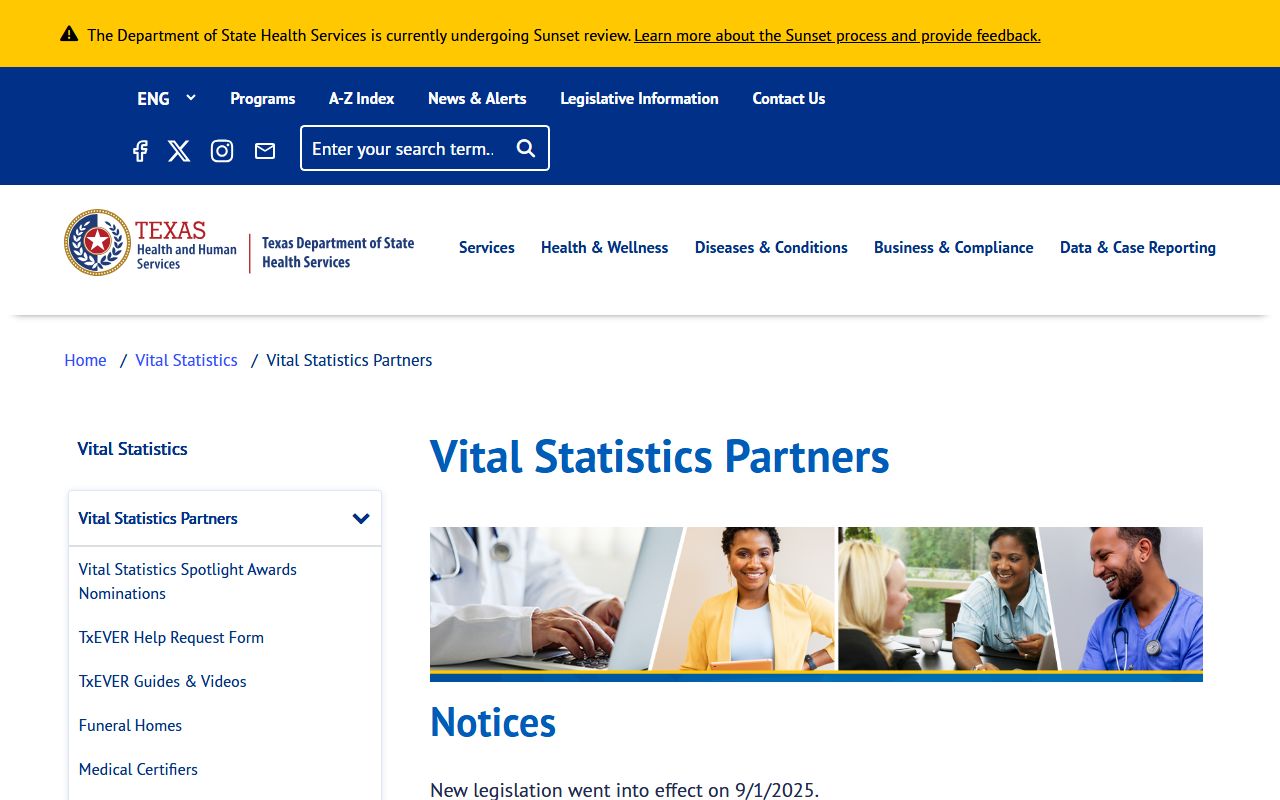
TxEVER sends timeliness prompts to each party involved, helping ensure that death certificates are filed within the 10-day window required by law.
Under Texas Health and Safety Code Section 193.003, death certificates must be filed within 10 days of the death. In counties with a medical examiner office (Harris, Dallas, Tarrant, Bexar, and Travis among others), the medical examiner certifies deaths requiring investigation. In other counties, a justice of the peace serves as the inquest authority under Texas Code of Criminal Procedure Chapter 49. Chapter 49 requires an inquest when a person dies in a suspicious manner, without medical attendance, from violence, or when the cause is unknown.
Texas Code of Criminal Procedure Chapter 49 governs death investigations and establishes when a justice of the peace or medical examiner must get involved before a death certificate can be completed and filed.
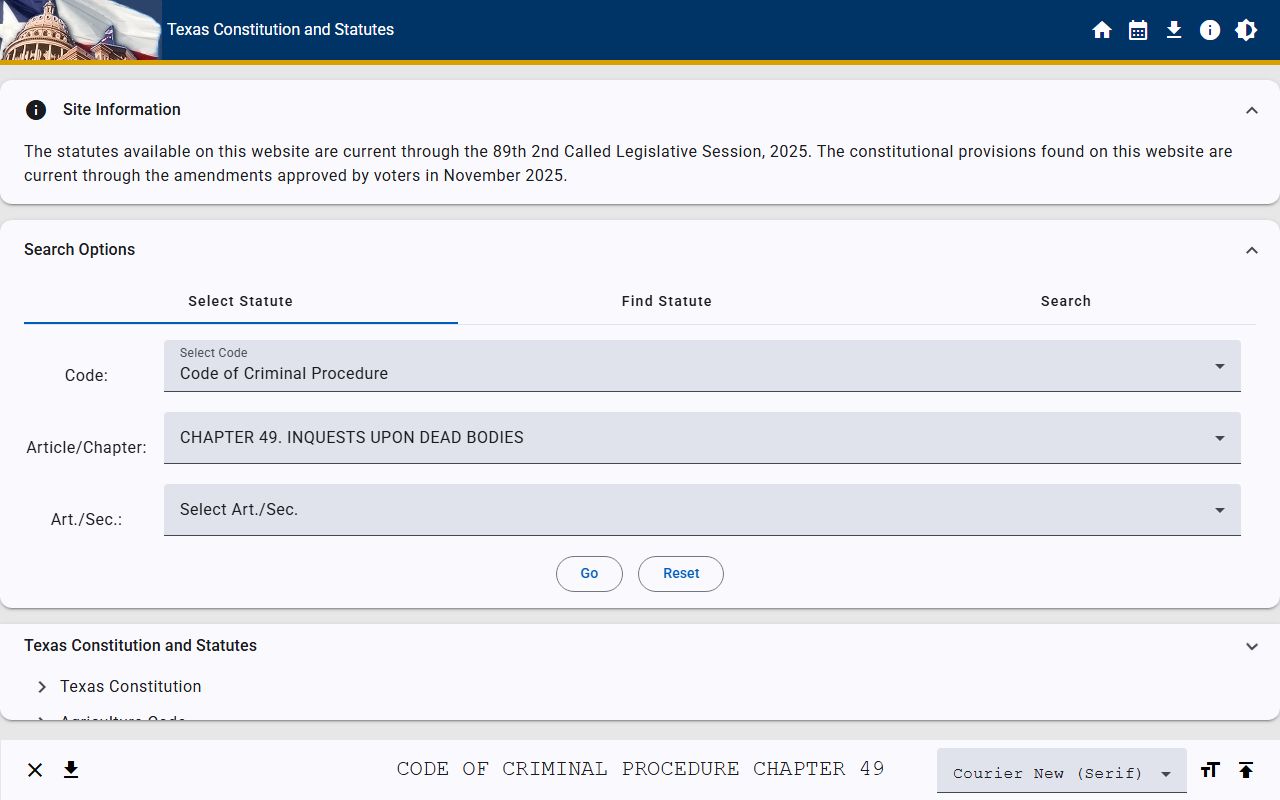
When the cause of death is still under investigation, certifiers enter "Pending Investigation" on the certificate and file it immediately, then amend it once the investigation concludes.
Texas Health and Safety Code Title 3 is the main statutory framework for vital records in Texas. Chapter 191 establishes DSHS authority. Chapter 193 covers death records specifically, including form requirements, filing responsibilities, and medical certification rules.
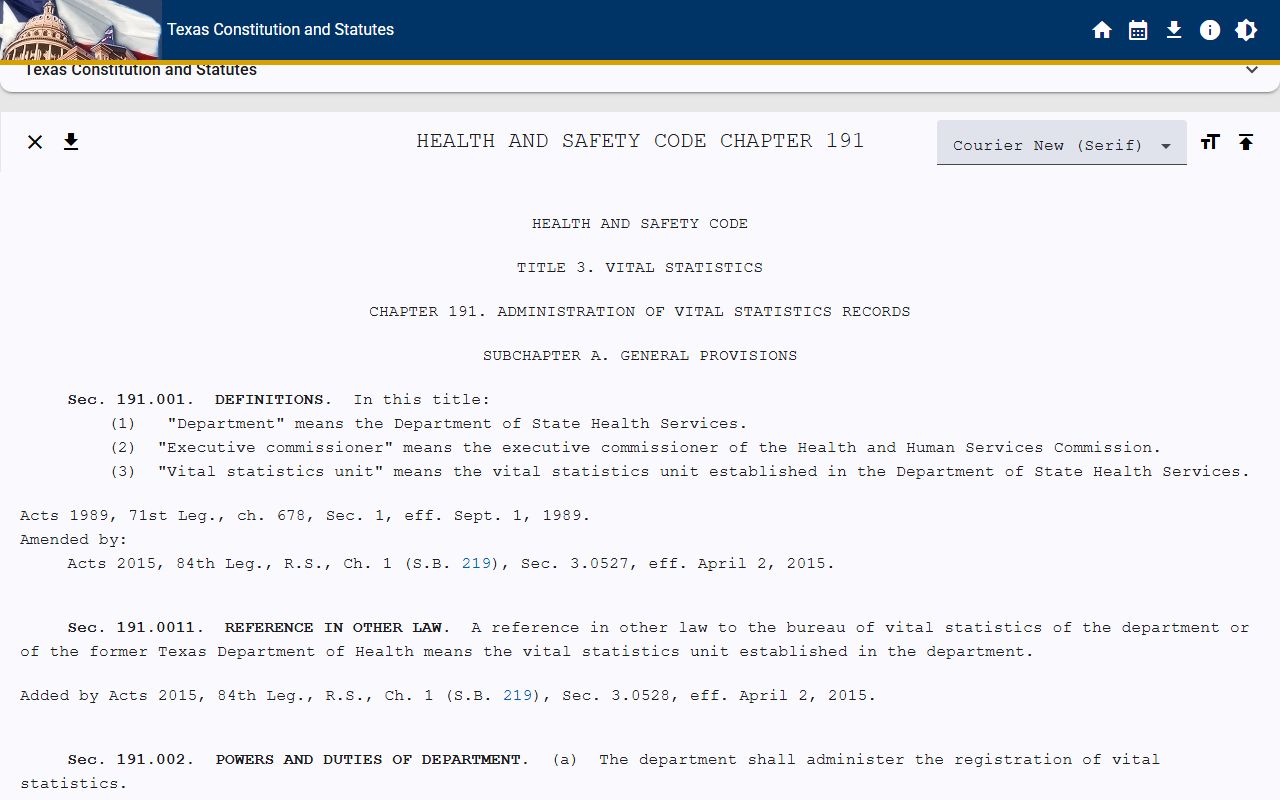
Section 193.002 places the filing responsibility on the person in charge of interment, typically the funeral director, who works through TxEVER to complete the registration.
Texas Administrative Code 25 TAC Chapter 181 sets the administrative rules for fees, acceptable identification, and who qualifies to request vital records.

The 2024 amendments to 25 TAC Chapter 181 raised the expedited service fee to $25 and consolidated all fee listings into a single table for clarity.
Historical Texas Death Records
Statewide death registration in Texas began in 1903. Full compliance took time, and records from the early years are incomplete, especially for rural areas and small counties. By the 1930s, coverage had improved significantly across the state. Records older than 25 years are open to the public and can also be found in several genealogical databases outside the DSHS system.
The Texas State Library and Archives Commission (TSLAC) holds one of the most valuable early collections of Texas vital records. Their Genealogy Collection includes vital record indexes, census records, and military records spanning three divisions. The Archives Division preserves colonial, republic, and state government records going back centuries. Their Local Records Division distributes microfilm copies to 26 repositories across Texas. Contact TSLAC at 1201 Brazos St., Austin, TX 78711-2927 or by phone at 512-463-5463, or email geninfo@tsl.state.tx.us.
The TSLAC genealogy collection page describes the full scope of their Texas vital records holdings and provides guidance on how to access early death records through their research services.
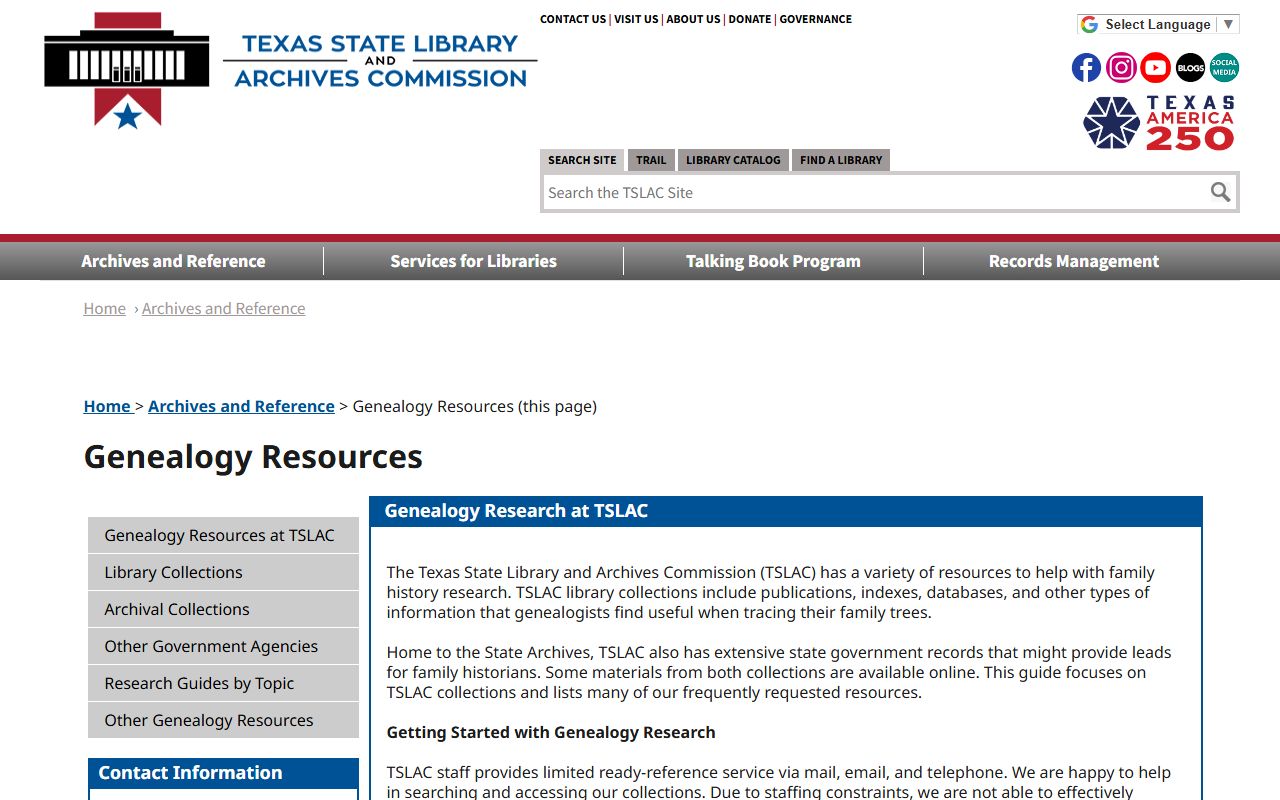
TSLAC also maintains the Texas Digital Archive with digitized records and a range of specialized databases including Confederate Pension Applications and Republic of Texas Claims.
FamilySearch offers free access to several Texas death record collections. These include Texas Deaths 1890-1976, Texas Deaths and Burials 1903-1973, and the Texas Death Index 1903-2000. A free account is required to view images. Many records are indexed and searchable by name, making it possible to locate older death records without visiting a physical archive. Go to FamilySearch Texas records to search their collections.
Ancestry.com has the Texas Death Certificates database covering 1903 to 1982 and the Texas Death Index for 1903 to 2000. A subscription is required, but many Texas public libraries provide free in-library access through the TexShare database program. Check with your local library to see if they carry Ancestry.
Ancestry's Texas death records collection includes digitized death certificates from 1903 to 1982 alongside a statewide death index covering the full 20th century, all searchable by name and date.
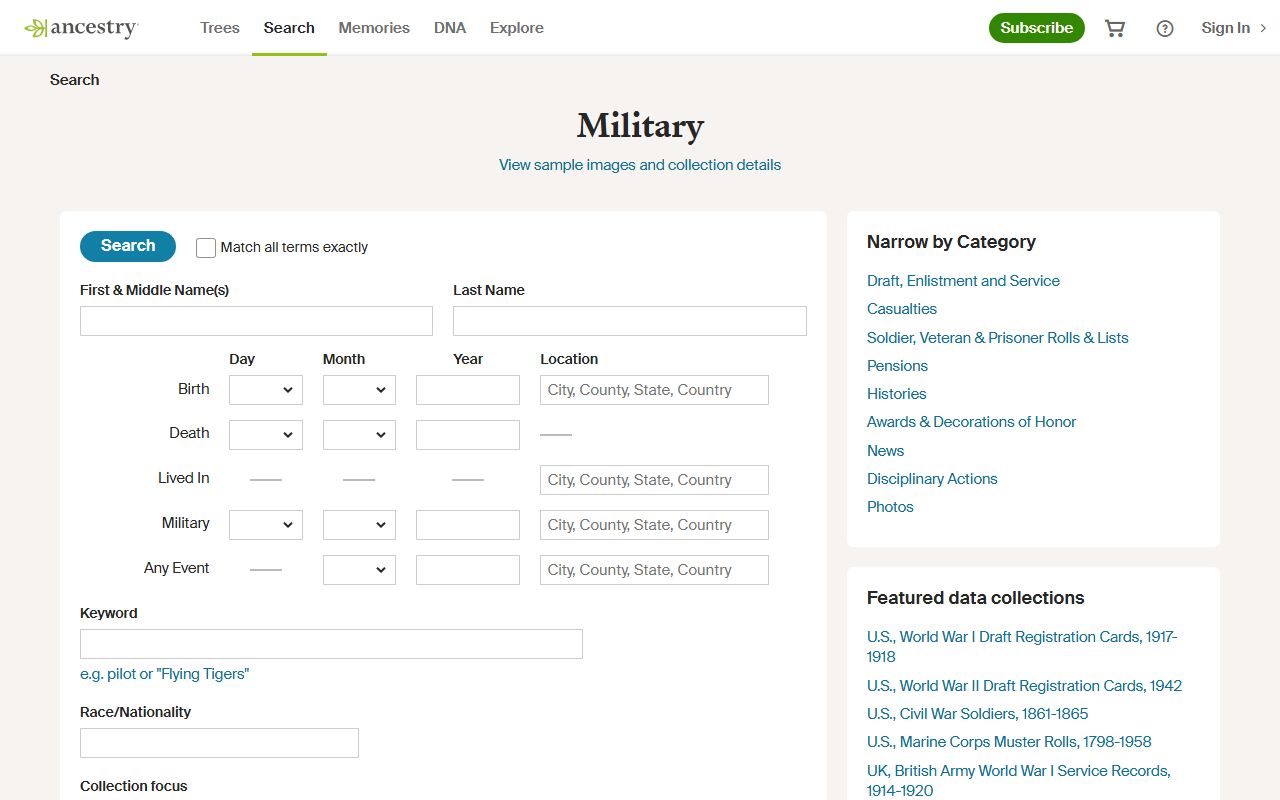
Ancestry databases are for genealogical research only. For certified copies needed for legal purposes, you must go through DSHS or the county clerk directly.
Note: Genealogy databases help confirm dates and counties but cannot issue certified copies. Contact DSHS or the county clerk for any official document you need for legal purposes.
Browse Texas Death Records by County
Each of Texas's 254 counties has a county clerk that holds local death records. Select a county below to find the clerk's contact information, address, phone, fees, and resources for death records in that area.
Texas Death Records by City
Several large Texas cities operate their own vital records offices separate from the county clerk. Select a city to find the right office for death certificates in that area.