
Search Montgomery County Death Records
Montgomery County death records are maintained by the County Clerk in Conroe and cover all deaths registered in the county since 1903. Whether you need a certified death certificate for an estate, insurance claim, or personal records, the Montgomery County Clerk offers in-person service at two locations and online ordering through a dedicated vital records portal. The county is one of the fastest-growing in Texas, and the clerk's office handles a high volume of vital record requests each year.
Montgomery County Overview
Montgomery County Clerk Office
| Office | Montgomery County Clerk |
|---|---|
| Main Address | 210 West Davis, Conroe, TX 77301 |
| Woodlands Branch | 1520 Lake Front Circle, The Woodlands, TX 77380 |
| Phone | (936) 539-7885 |
| Hours | Monday-Friday, 8:00 AM - 5:00 PM |
| Website | mctx.org |
| Online Orders | montgomerytxvitals.permitium.com |
Note: Texas Senate Bill 16 requires valid photo ID for all official public record filings submitted at this office.
The Montgomery County Clerk's office serves as the local custodian of all death records filed in the county. The main branch in Conroe handles the bulk of in-person requests. The Woodlands branch office at 1520 Lake Front Circle is a convenient option for residents in the northern part of the county.
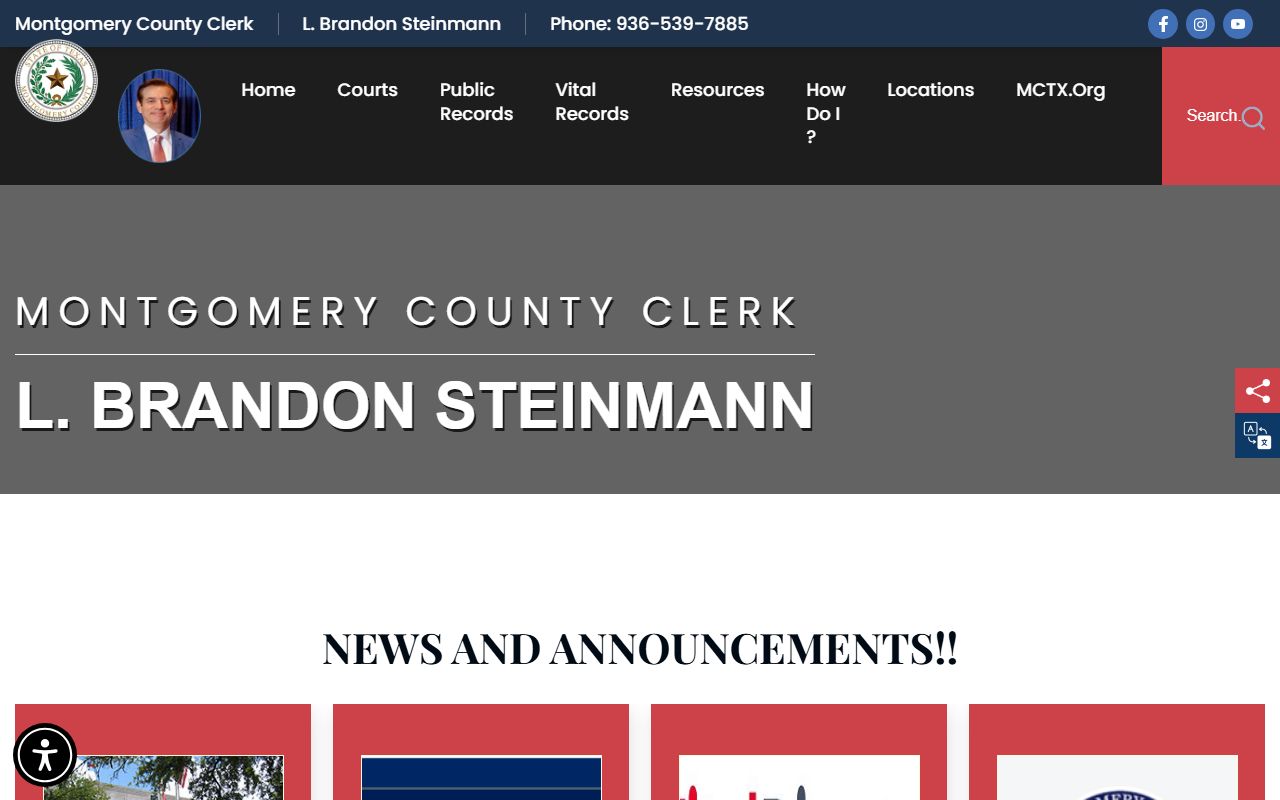
Both locations can issue certified death certificates. Call ahead to confirm which services are available at each branch before making the trip, since some specialized requests may only be processed at the main Conroe office.
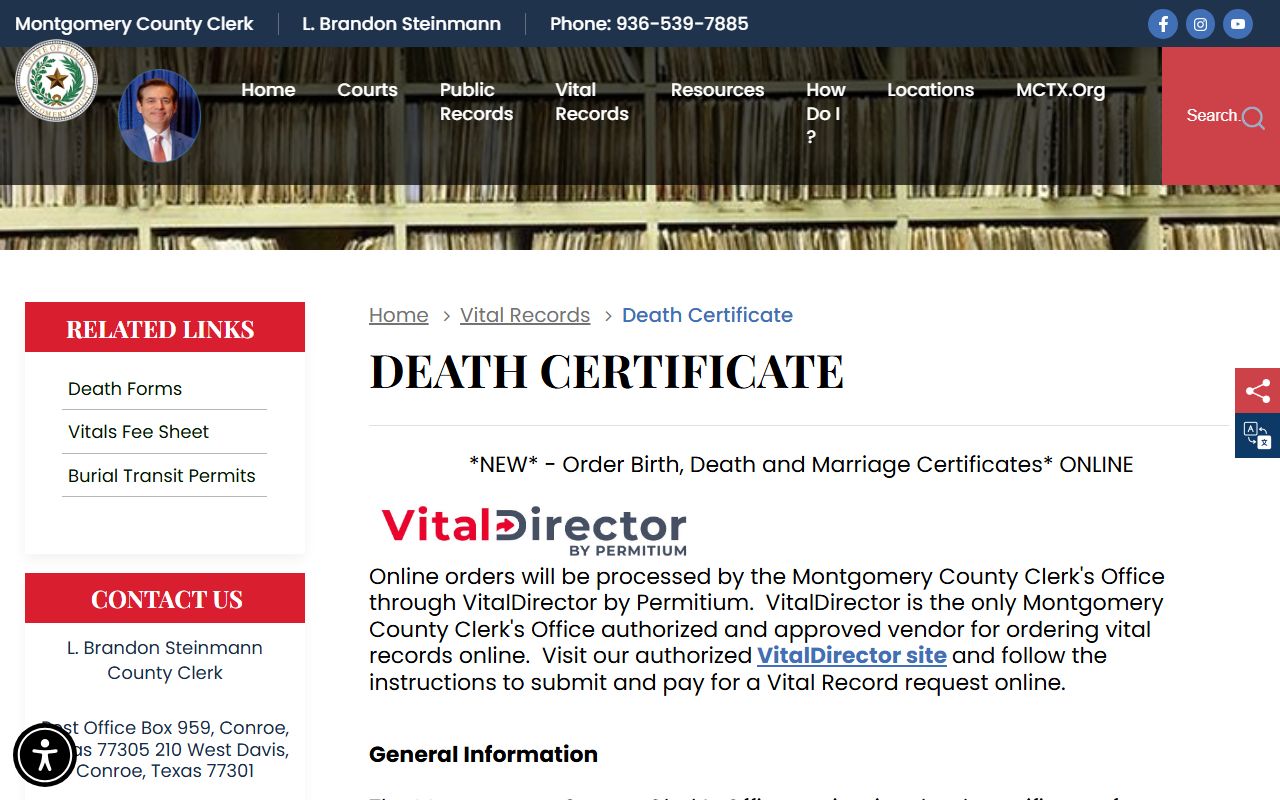
Montgomery County also offers an online ordering system through Permitium. This lets you order certified copies of death records without visiting an office in person. You will need to create an account, provide identifying details about the deceased and your relationship to them, and pay by credit card. Orders placed online are processed during regular business hours.
Getting a Certified Death Certificate
A certified death certificate is a legal document needed for settling estates, claiming life insurance, transferring property titles, and closing bank accounts. The Montgomery County Clerk issues certified copies for all deaths that took place within the county.
To request a copy, you need to know the full legal name of the person who died, the date of death, and the location of death within the county. You also need to show a valid photo ID and explain your relationship to the deceased. Under Texas law, only certain people can get a certified copy of a death record that is less than 25 years old.
The Montgomery County death certificate page has step-by-step instructions for requesting a certified copy in person or by mail.
For deaths that occurred in the City of Kingwood, note that some parts of Kingwood fall within Harris County rather than Montgomery County. If the death occurred in a Kingwood area that is part of the City of Houston, you will need to contact Houston or Harris County for the record rather than the Montgomery County Clerk.
If you are unsure which county holds the record, check the address where the death occurred against county boundary maps, or call both clerk offices to ask. DSHS can also help determine which county filed a given record if you are not sure where to start.
Who Can Request Death Records
Texas restricts access to death records for 25 years after the date of death. During that period, only authorized individuals may get a certified copy. Authorized requestors include the surviving spouse, an adult child, a parent, a sibling, or a grandparent of the deceased. A legal guardian or attorney acting on behalf of an authorized person can also request the record.
Once a death record is more than 25 years old, it becomes a public record. Anyone may request a copy without having to prove a relationship to the deceased. You still need to provide enough identifying information for the clerk to find the record and you still pay the standard fee.
If you need a record but do not qualify as an authorized requestor, and the record is less than 25 years old, a court order is required. Talk to a licensed attorney in Texas for help with that process. The clerk's office cannot grant access outside the rules set by state law, even in urgent situations.
Identification requirements are set by state law. The DSHS list of acceptable IDs applies to both county and state-level requests. Acceptable IDs include a Texas driver's license, a U.S. passport, a military ID, or another government-issued photo ID.
Fees and Payment
The standard fee for a certified death certificate from the Montgomery County Clerk is $21 for the first copy. Each additional copy of the same record ordered at the same time costs $4. These fees are set by the Texas Legislature and apply to all county clerk offices in the state.
The Montgomery County online portal at montgomerytxvitals.permitium.com accepts major credit cards. In-person payments at the Conroe and Woodlands offices may be made by cash, check, money order, or credit card. It is a good idea to call ahead and confirm accepted payment methods before visiting.
If you order through the Texas Department of State Health Services instead of the county clerk, DSHS charges $20 for the first certified copy and $3 for each additional copy. Online orders placed through VitalChek include a service fee of around $11 to $13 on top of the certificate cost. That brings a single online order to roughly $31 to $33 total.
All fees are nonrefundable. If the clerk searches and cannot find the record, you may receive a "no record found" statement. This document can sometimes be used in legal proceedings as evidence that no record exists.
Texas Law and Death Record Requirements
Death records in Texas are governed by the Texas Health and Safety Code, Chapter 191. This chapter sets the rules for who must file a death certificate, what information it must contain, when it must be filed, and how records can be accessed by the public.
Under state law, a death certificate must be filed within ten days of the date of death or the date a body is discovered. The funeral director handling disposition of the remains is typically responsible for filing. A licensed physician, medical examiner, or justice of the peace must certify the cause of death before the certificate is complete.
When a death involves unusual circumstances such as an accident, suicide, or homicide, the case falls under the inquest process governed by Texas Code of Criminal Procedure, Chapter 49. Montgomery County has a medical examiner who handles these cases. Deaths investigated by the medical examiner may result in additional records beyond the standard death certificate.
Texas processes all death filings through the TxEVER system, a statewide electronic vital events registration platform. Hospitals, funeral homes, and physicians use TxEVER to file and sign death certificates digitally. This system helps ensure that records are accurate, complete, and available to county clerks and the DSHS registry in a timely way.
Access restrictions for recent records are found in 25 TAC Section 181.31, which sets the 25-year rule and defines who qualifies as an authorized requestor for restricted records.
Historical Death Records and Genealogy
Montgomery County has been a settled part of Texas for well over a century, and death records going back to the early 1900s can be found through the county clerk and state archives. Older certificates often include details such as the deceased's birthplace, parents' names, and occupation, which are helpful for building family trees.
The Texas State Library and Archives Commission keeps historical vital records and related documents. Their genealogy resources page is a good place to start if you are looking for records that predate modern registration or that may have been transferred out of county custody over the years.
FamilySearch has a free Texas collection that includes death certificates, death indexes, and cemetery records. Their Texas records page covers many counties including Montgomery and is fully searchable without a paid account.
Ancestry.com offers a broader database that includes death indexes, obituary collections, and funeral home records. Their vital records search is subscription-based but often turns up records not found elsewhere, especially for the period between 1903 and 1950 when record-keeping varied in quality from county to county.
Local libraries in Conroe and The Woodlands may have microfilm collections, newspaper obituary archives, and other local resources that supplement official records. Genealogical societies operating in the county can also help connect you with volunteers who have done research in local cemeteries and courthouse archives.
State-Level Death Record Requests
The Texas Department of State Health Services serves as the central repository for all death records filed in Texas since 1903. DSHS can provide certified copies of Montgomery County death records just as the county clerk can. Their main office is at 1100 W. 49th St., Austin, TX 78756, with mail requests sent to P.O. Box 12040, Austin, TX 78711-2040.
Reach the DSHS vital statistics unit at (888) 963-7111. Staff are available during regular business hours and can answer questions about required documents, current wait times, and how to submit requests from out of state.
The DSHS vital statistics page has request forms, fee schedules, and the full list of acceptable IDs. For urgent needs, expedited processing is available for an extra fee. Expedited requests sent by overnight mail to DSHS may be turned around faster than standard processing.
Online orders go through VitalChek, the official online vendor for DSHS. You can order a death certificate from any Texas county through VitalChek regardless of where you live. The process takes about 10 to 15 minutes to complete online, and delivery typically happens within 7 to 14 business days by first-class mail.
For most residents of Montgomery County, going to the county clerk in Conroe or using the county's own online portal is the most direct route. However, DSHS is a reliable option if the county office is closed, if you are out of the area, or if you need a record that spans across county lines.
Cities in Montgomery County
Montgomery County's largest city is Conroe, the county seat, which qualifies for its own records page. Other communities in the county include The Woodlands, Magnolia, Willis, Conroe, and Splendora. The Woodlands is a large planned community but does not meet the 100,000 population threshold for a separate city page under this directory.
Nearby Counties
For deaths that occurred in adjacent areas, you may need to contact neighboring county clerks. See pages for Harris County, Waller County, Grimes County, Walker County, San Jacinto County, and Liberty County.