
El Paso County Death Records
El Paso County death records date back to 1873 and are maintained by the County Clerk in downtown El Paso, with statewide copies also held by Texas DSHS, giving residents and researchers two reliable paths to certified death certificates and historical records.
El Paso County Overview
El Paso County Clerk Office
| Office | El Paso County Clerk |
|---|---|
| Address | 500 E. San Antonio, Suite 105, El Paso, TX 79901 |
| Phone | (915) 546-2071 |
| Hours | Monday-Friday, 8:00 AM - 5:00 PM |
| Website | epcounty.com |
Note: Texas Senate Bill 16 requires valid photo ID for all official public record filings submitted at this office.
The El Paso County Clerk maintains death records for all deaths that occurred within El Paso County, which borders both New Mexico to the north and Mexico to the south. Records at the county level go back to 1873, making El Paso one of the Texas counties with the longest local record history. The office is located at Suite 105 in the county building at 500 E. San Antonio in downtown El Paso.
The clerk's office handles a high volume of requests given El Paso's large population. Arriving early in the day and having all required documents ready will speed up the in-person process. Staff issue certified copies at the counter for eligible requestors. Photo ID is required for all requests under the SB 16 requirement and under Texas vital records access rules.
Mail requests are accepted at the same address. Submit a written request, a copy of your photo ID, the name and date of death of the deceased, your relationship to them, and a check or money order payable to the El Paso County Clerk. Processing times for mail requests are generally five to ten business days, though demand can push that timeline longer during busy periods.
Getting a Certified Death Certificate
El Paso County residents and family members of people who died in El Paso County can get certified death certificates several ways. The method you choose affects how fast you receive your document and what it costs.
In person: Visit the El Paso County Clerk at Suite 105, 500 E. San Antonio. Bring photo ID and payment. Staff issue certified copies while you wait for recent filings. Older records may require a short additional wait.
By mail: Send your written request to the clerk. Include all required information and a check for the fee. Expect one to two weeks for processing and return delivery.
Through DSHS: The Texas DSHS Vital Statistics office issues certified death certificates for all Texas deaths recorded since 1903. Orders are accepted by mail, in person in Austin, or online through the Texas.gov vital records portal. VitalChek is also authorized to process orders on behalf of DSHS.
El Paso County Clerk's website provides current information on forms, fees, and office hours for all vital record requests.
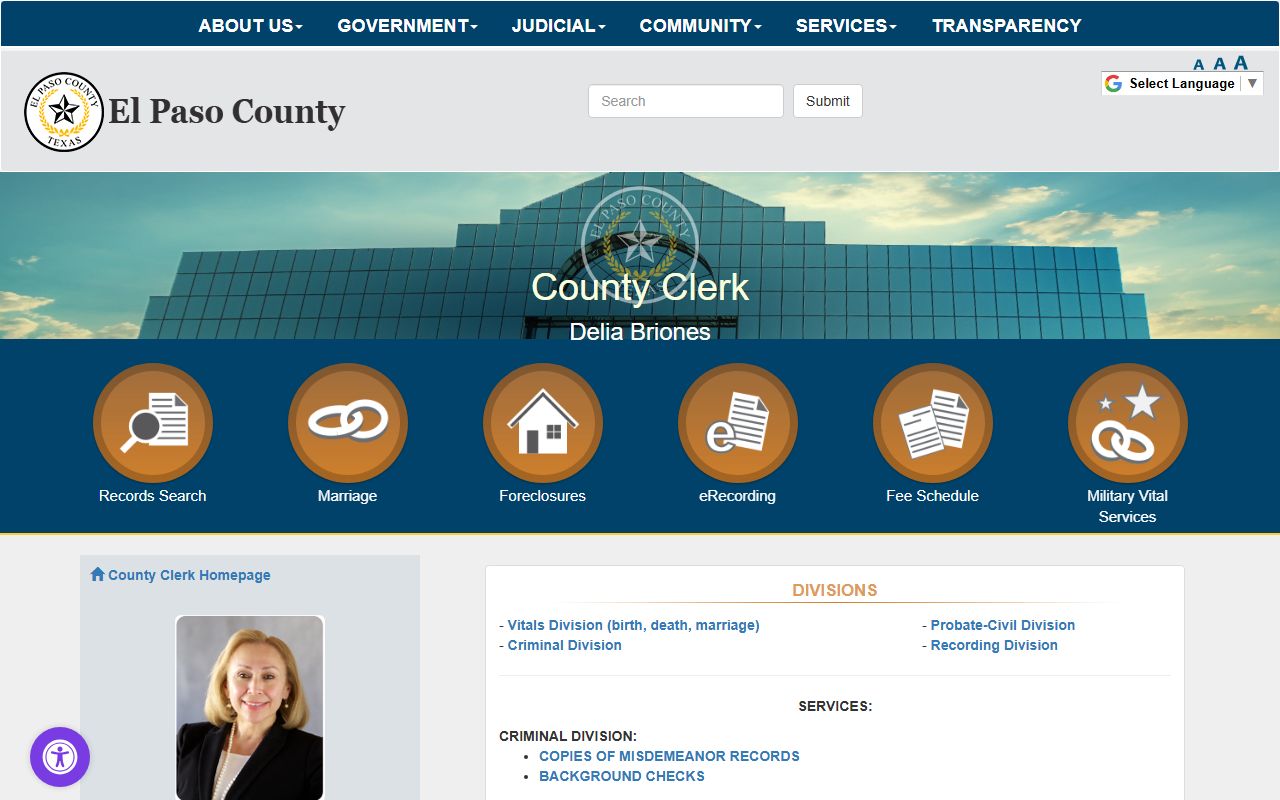
The county clerk's office page covers all the steps needed to request birth and death certificates in person, by mail, or online through the state system.
Who Can Request Death Records
Texas law restricts access to death certificates for the 25 years following the date of death. Records older than 25 years are public and open to anyone without proof of eligibility.
For deaths within the restricted period, only eligible individuals may receive a certified copy. Qualifying requestors include the deceased's spouse, parent, child, adult sibling, or grandparent. Attorneys with written authorization from an eligible family member may also request records. All requestors must present a valid government-issued photo ID. DSHS publishes a list of acceptable ID types that applies at both county and state offices.
Informational copies are available to a wider group. These copies are stamped "not for legal use" and cannot be submitted to government agencies, banks, or courts, but they work well for genealogy and personal research. El Paso County's large and diverse population includes many families tracing roots on both sides of the border, so informational copies are frequently used for cross-border family research purposes.
Courts, law enforcement, and government agencies have separate administrative access to records not subject to the standard public access restrictions. Medical examiners, coroners, and funeral homes also have authorized access for professional purposes.
Fees and Payment
The El Paso County Clerk charges $21 for the first certified copy of a death certificate and $4 for each additional copy ordered at the same time. These fees are set by Texas state statute and are uniform across all county clerks in Texas.
In-person payment options at the downtown El Paso office typically include cash, check, and credit card. Confirm current payment methods by calling (915) 546-2071 before your visit. Mail requests require a check or money order payable to the El Paso County Clerk.
DSHS state-level fees are $20 for the first copy and $3 per additional copy. Online orders through the Texas.gov portal or VitalChek carry a service fee of approximately $10 to $12, plus optional expedited shipping. The total cost for a single online state order with standard shipping is typically $30 to $35.
If you need several certified copies for different purposes, like settling an estate, claiming life insurance, or handling Social Security benefits, order them all at once. Each additional copy costs only $4 at the county level. Ordering separately later means paying the full $21 base fee again.
Texas Law and Death Record Requirements
All Texas death records are filed and maintained under the Texas Health and Safety Code, Chapter 191. This chapter governs registration requirements, the content of death certificates, access rules, and long-term retention of records.
A death certificate must be completed and filed within ten days of death. The funeral director or person responsible for disposition files the certificate with the local registrar. The attending physician, medical examiner, or justice of the peace certifies the cause of death. El Paso County has a medical examiner's office that handles unnatural or unexplained deaths under Texas Code of Criminal Procedure, Chapter 49.
El Paso County's position on the U.S.-Mexico border creates some unique record-keeping situations. Deaths that occur near the border sometimes involve questions about jurisdiction, and the county clerk and medical examiner work with federal agencies when needed. Deaths of Texas residents that occur in Mexico are not recorded in the Texas system, and families may need to contact Mexican civil registry offices for those records.
Texas processes all vital records through the TxEVER electronic platform, which connects funeral homes, hospitals, county clerks, and DSHS. Administrative rules for this system are published in Texas Administrative Code, Title 25, Chapter 181.
Historical Death Records and Genealogy
El Paso County death records go back to 1873, earlier than statewide registration began, making the local clerk's archive one of the most historically rich in far West Texas. For genealogy work, several resources can help you access older records.
The Texas State Library and Archives Commission (TSLAC) holds statewide death indexes and microfilm collections. Their collections include El Paso County records, particularly from the pre-digital era. TSLAC resources are available in person in Austin and through online finding aids.
FamilySearch provides free access to Texas death collections including indexes and scanned certificates. Given El Paso's history as a major borderland community, some records in the FamilySearch collection include bilingual information and cross-references to Mexican civil registry data. It is worth checking both the Texas and Chihuahua, Mexico, collections for families with roots on both sides of the border.
Ancestry.com has Texas death records including the Social Security Death Index, newspaper obituaries from the El Paso Times and other local papers, and digitized certificates. A subscription is needed for full image access. Many El Paso area libraries offer free Ancestry access through their digital services programs.
The El Paso County Historical Society and the University of Texas at El Paso Special Collections also hold local records, newspapers, and community archives that can supplement official death record searches for hard-to-find cases.
State-Level Death Record Requests
The Texas DSHS Vital Statistics Section maintains all Texas death records registered since 1903 in a centralized statewide database. For El Paso County, the state is an equally valid source to the county clerk for deaths from 1903 onward.
DSHS accepts requests by mail at P.O. Box 12040, Austin TX 78711-2040. In-person service is available at 1100 W. 49th St., Austin TX 78756. Reach the agency by phone at (888) 963-7111 for questions. Standard processing time is 10 to 15 business days.
The Texas.gov vital records portal and VitalChek both allow online ordering. Both produce official certified copies and accept major credit cards. VitalChek is a DSHS-authorized vendor, so orders placed there carry full legal weight.
If you need records for someone who died in Texas but you're not sure of the county, DSHS can search statewide by name. This is particularly useful for El Paso families who may have relatives spread across different Texas counties or who moved to El Paso from elsewhere in the state.
Cities in El Paso County
El Paso County is home to El Paso, the county seat and the largest city in far West Texas with a population well over 600,000. El Paso has its own dedicated city page with additional local resources and information specific to the city. Other smaller communities in El Paso County include Socorro, San Elizario, and Horizon City, but these do not reach the 100,000-population threshold for individual city pages.
Nearby Counties
El Paso County is bordered primarily by New Mexico and Mexico. The only adjacent Texas county is Hudspeth County to the east.