
Lubbock County Death Records
Lubbock County death records are held by the County Clerk at the courthouse in downtown Lubbock, and the office has maintained these filings since Texas began its statewide registration system in 1903. If you need a certified death certificate for an estate, insurance claim, pension, or other legal matter, you can request one in person, by mail, or through the state's online portal. The clerk's office keeps records for deaths that occurred within the county, while the City of Lubbock also operates its own vital statistics office for deaths handled through the city.
Lubbock County Overview
Lubbock County Clerk Office
| Office | Lubbock County Clerk |
|---|---|
| Address | 904 Broadway, Suite 207, Lubbock, TX 79401 |
| Phone | (806) 775-1047 |
| Hours | Monday-Friday, 8:00 AM - 5:00 PM |
| Website | lubbockcounty.gov |
Note: Texas Senate Bill 16 requires valid photo ID for all official public record filings submitted at this office.
The Lubbock County Clerk is located on the second floor of the Tom Green County Courthouse building at 904 Broadway in downtown Lubbock. Walk-in service is available during business hours. The office handles death certificate filings for deaths that occurred anywhere within the county, including in the city of Lubbock and in smaller communities such as Slaton, Wolfforth, and Shallowater.
The county clerk also maintains an online records search portal where you can look up filings by name and date range. This is useful for confirming whether a death was filed in Lubbock County before making an in-person trip. Not all historical records from early decades may be indexed, so older requests sometimes need extra time to process.
The Lubbock County Clerk department page lists current contact details and any policy updates.

Staff can help you identify whether the record you need is on file locally or whether you should contact the state agency in Austin.
The Lubbock County online records search lets you search filings by name, document type, or recording date.
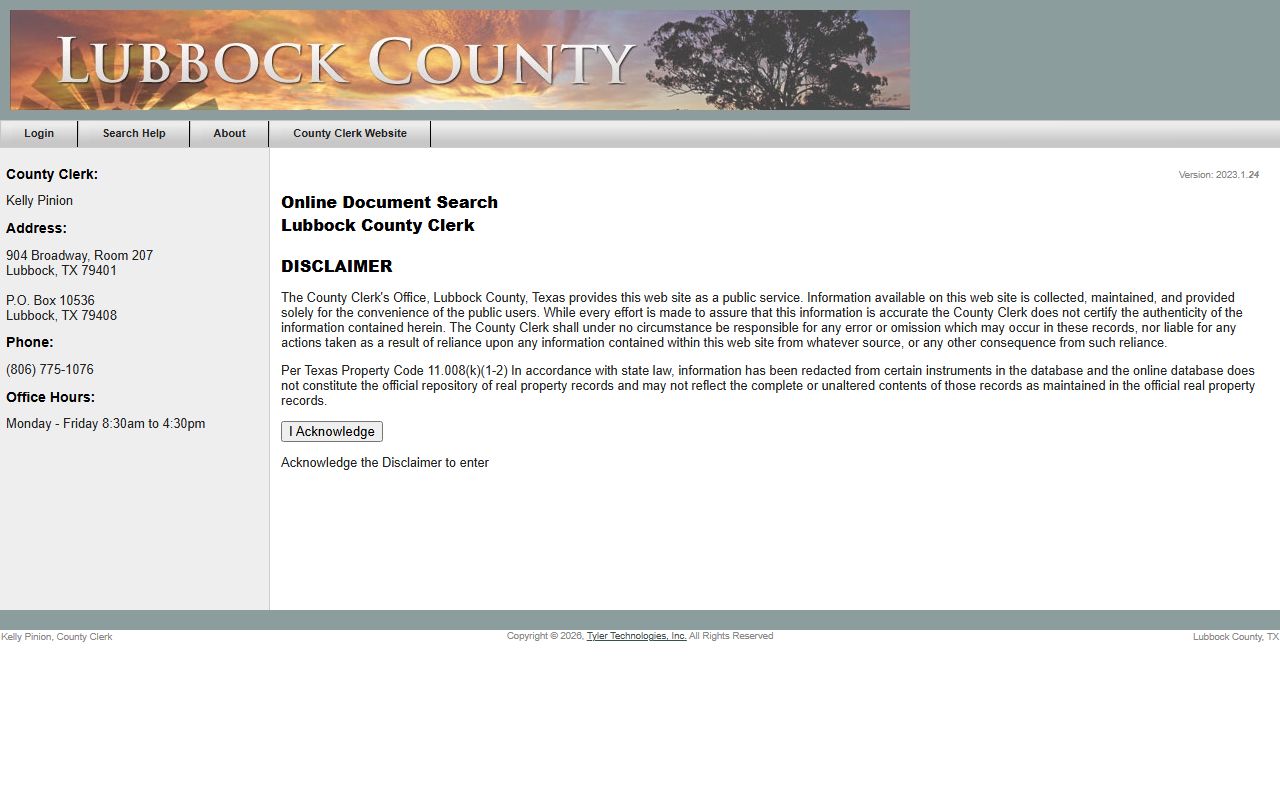
Use this portal to confirm a death record exists before requesting a certified copy in person or by mail.
Getting a Certified Death Certificate
A certified death certificate from Lubbock County costs $21 for the first copy. Each additional copy ordered at the same time is $4. These fees are set by the Texas Legislature and apply to all county clerks statewide. You pay this fee whether you request in person, by mail, or through an authorized third-party service.
To request in person, bring a valid photo ID and the completed request form. The clerk's office at 904 Broadway can provide the form at the counter, or you can download it from the county website before your visit. In-person requests are usually filled the same day if the record is on file.
For mail requests, send a written request that includes the full name of the deceased, the date of death, and your relationship to the person. Attach a copy of your photo ID and a check or money order payable to the Lubbock County Clerk. Mail to 904 Broadway, Suite 207, Lubbock, TX 79401. Allow two to four weeks for mail processing.
The City of Lubbock also operates a separate vital statistics office. Deaths handled through the city's registration system may be available from either the city office or the county clerk. If you are not sure which office has the record, call (806) 775-1047 first.
You can also order a certified copy through the Texas Department of State Health Services or through authorized online services such as VitalChek. State orders take longer and cost slightly more, but they work for any death that occurred in Texas regardless of county.
Who Can Request Death Records
Texas law restricts access to death certificates that are less than 25 years old. During this restricted period, only certain people can get a certified copy. Those who qualify include the spouse, parent, child, or sibling of the deceased. Legal representatives acting on behalf of those relatives may also request copies.
If you don't qualify under the restricted list, you can still get a death record if you show a direct and tangible need. This could include legal matters such as settling an estate, resolving a life insurance claim, or proving the death in a probate proceeding. The clerk's office will ask you to explain your need and may require supporting documents.
Death records that are 25 years old or older are considered public and can be requested by anyone. You do not need to explain your reason for wanting an older record. These older records are also the most commonly used for genealogy research.
Acceptable forms of photo ID include a Texas driver's license, a state ID card, a U.S. passport, or a military ID. The DSHS list of acceptable IDs covers all forms the state recognizes for vital record requests.
Fees and Payment
The Lubbock County Clerk charges $21 for the first certified death certificate and $4 for each additional copy of the same record ordered at the same time. Payment at the counter can be made by cash, check, or money order. Call ahead to confirm whether credit or debit cards are accepted.
If you order through the Texas Department of State Health Services directly, the fee structure is a bit different. DSHS charges $20 for the first certified copy and $3 for each additional copy ordered at the same time. DSHS also offers a 24-hour expedite option for an additional $25. You can reach DSHS at (888) 963-7111 or write to them at 1100 W. 49th St., Austin, TX 78756. Mail requests go to P.O. Box 12040, Austin, TX 78711-2040.
Online orders through VitalChek carry an additional convenience fee on top of the state or county fee. The exact amount depends on the delivery option you choose. Standard mail delivery is the cheapest option; overnight shipping costs more.
Make checks payable to the Lubbock County Clerk for county requests. For DSHS mail orders, make the check payable to DSHS. Do not send cash through the mail.
Texas Law and Death Record Requirements
Texas Health and Safety Code Chapter 191 governs the registration of vital records, including death certificates. Under this law, a death must be registered within 10 days of the date of death. The funeral director or person who handled the body is responsible for filing the certificate with the local registrar.
The certificate must include the full legal name of the deceased, the date and place of death, the cause of death as certified by a physician or medical examiner, and identifying information such as date of birth and Social Security number. Any amendments made to a death certificate after filing are noted on the record.
Texas Code of Criminal Procedure Chapter 49 covers inquests and medical examiner proceedings. When a death is sudden, unexplained, or occurs without a physician present, a justice of the peace or a medical examiner may conduct an inquest before the death certificate can be finalized. Lubbock County has its own medical examiner's office, which handles such cases locally.
The state uses the Texas Electronic Vital Events Registrar, known as TxEVER, to process and store all birth and death records. This system allows authorized users to file and access records electronically. Funeral homes, hospitals, and county offices all use TxEVER. The full text of Health and Safety Code Chapter 191 is available on the Texas Legislature's website.
Access rules are also governed by Title 25, Part 1, Chapter 181 of the Texas Administrative Code, which sets out the rules for who may access vital statistics records and under what conditions.
Historical Death Records and Genealogy
Lubbock County death records go back to 1903, when Texas made death registration mandatory statewide. Some records from before that date may exist in the form of church registers, cemetery records, or early probate filings, though these are informal and not part of the official county record system.
For genealogy research, there are several good starting points. The Texas State Library and Archives Commission holds historical vital records and can help you find older filings that may not be available through the county. Their archives include death records from across the state going back to the early statehood era.
FamilySearch has a large collection of Texas vital records that are free to search and view. Their Texas death records collection covers many years and can be searched by name, county, and date. This is often the fastest way to find a historical death record without visiting the courthouse in person.
Ancestry.com also holds Texas death indexes and some digitized certificates. A subscription is required, but many public libraries offer free access to Ancestry for cardholders.
The West Texas Collection at Texas Tech University in Lubbock holds local history materials including some death-related records, obituaries, and funeral home records for the South Plains region. These can be useful for filling in gaps in the official record system.
State-Level Death Record Requests
If you prefer to request a death certificate directly from the state rather than the county, the Texas Department of State Health Services Vital Statistics Section handles statewide orders. You can reach them online at dshs.texas.gov/vital-statistics or by phone at (888) 963-7111.
The DSHS can fill requests for any death that occurred in Texas, regardless of which county. This is useful if you are not sure exactly where in Texas the death was registered, or if you want a single source for multiple records from different counties.
The Texas.gov vital records portal lets you order certified death certificates online from anywhere in Texas.

Online orders are processed statewide and arrive within 7 to 14 business days.
DSHS mail requests go to P.O. Box 12040, Austin, TX 78711-2040. If you need to visit the office in person, the address is 1100 W. 49th St., Austin, TX 78756. The DSHS vital statistics office is open during regular state business hours. Additional details about acceptable documents and forms are at dshs.texas.gov/vs/death.
Cities in Lubbock County
Lubbock is the county seat and the only city in Lubbock County that qualifies for its own records page. You can find city-specific death records information at Lubbock. Smaller communities in the county, including Slaton, Wolfforth, Shallowater, and Idalou, do not meet the population threshold for separate pages; death records for those areas are handled through the Lubbock County Clerk's office.
Nearby Counties
Death records for residents near the Lubbock County border may be filed in a neighboring county. Check these offices if your search at the Lubbock County Clerk does not return results: Hockley County, Terry County, Lynn County, Crosby County, Floyd County, Hale County, Lamb County, Yoakum County.