
McAllen Death Records Lookup
McAllen death records for deaths within city limits are handled by the McAllen City Secretary's Vital Statistics Division, which serves as the local registrar. Deaths outside the city but within Hidalgo County go to the Hidalgo County Clerk. This page covers both offices, how to request records, what fees apply, and what Texas law says about access.
McAllen Overview
Where to Get McAllen Death Records
The McAllen City Secretary's office handles vital records registration including death certificates for deaths within city limits. The City Secretary serves as the local registrar and processes certified copy requests for McAllen residents. This is the first place to look for deaths that occurred inside McAllen.
The City Secretary serves as the local registrar and processes certified copy requests for McAllen residents. McAllen birth and death records are linked to the state system and go back to 1904 for the city. For deaths outside McAllen city limits but within Hidalgo County, the Hidalgo County Clerk handles requests.
| Office | McAllen City Secretary - Vital Statistics Division |
|---|---|
| Website | mcallen.net/departments/secretary/vitals |
| Office | Hidalgo County Clerk |
|---|---|
| Address | 100 North Closner, Edinburg, TX 78539 |
| Phone | (956) 318-2100 |
If you are not sure which office has the record, call the Hidalgo County Clerk first. They can confirm whether the death was registered at the city or county level and direct you accordingly.
Note: Texas SB 16 requires valid photo ID for all vital records requests. Bring a government-issued ID to either office.
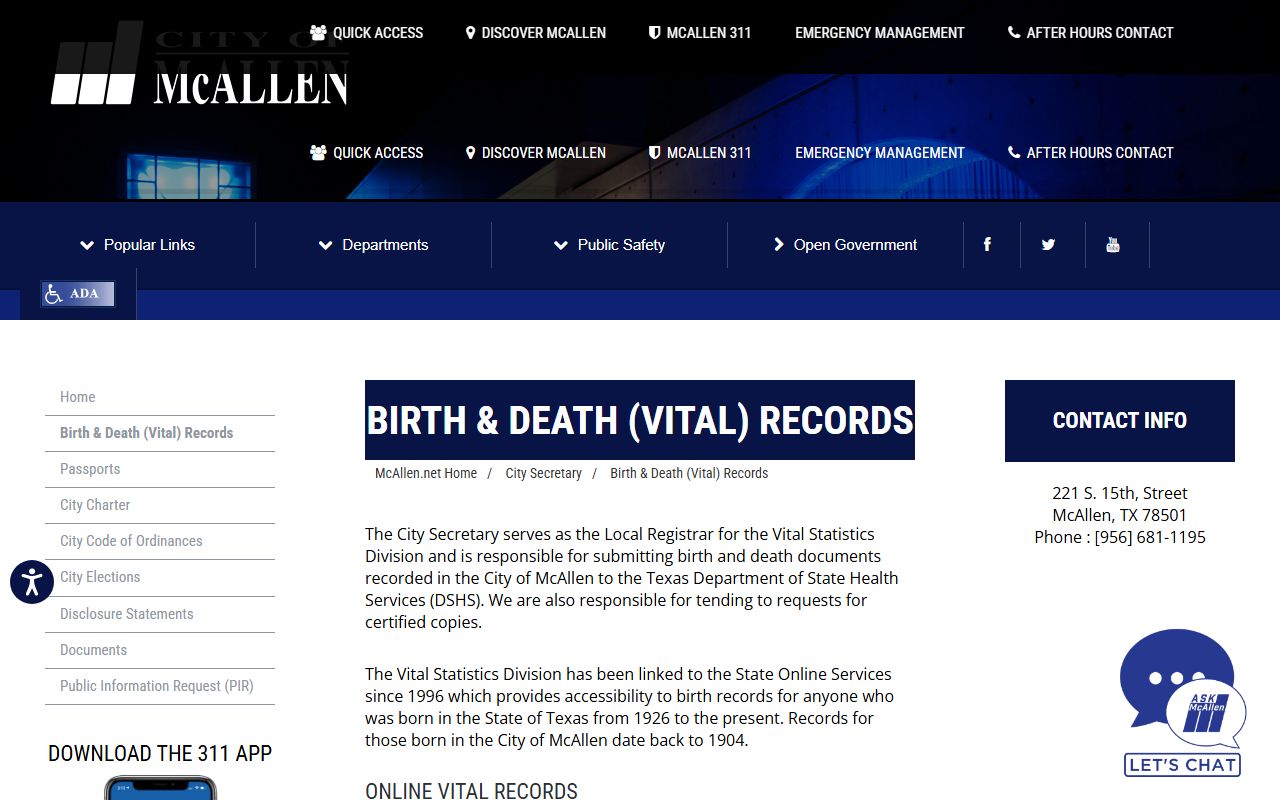
The McAllen City Secretary page shows current requirements, accepted forms of ID, and how to schedule or submit a records request.
How to Get a Certified Copy
McAllen residents can request a death certificate from the City Secretary, from Hidalgo County, or through state channels. Each route has different processing times and requirements.
In person at the McAllen City Secretary office or the Hidalgo County Clerk in Edinburg. Bring valid photo ID, complete the request form, and pay the fee. In-person requests are usually handled the same day during business hours.
Online through Texas.gov or VitalChek. Both connect to the statewide TxEVER system. A service fee is added on top of the certificate fee. Allow 7 to 14 business days for delivery. This is a good option if you cannot travel to either office.
By mail, send a completed application, a copy of your photo ID, and a check or money order. Mail requests to the appropriate office based on where the death occurred. Allow 3 to 4 weeks for processing and return delivery. Include a self-addressed stamped envelope.
Through DSHS at dshs.texas.gov/vs/death. The state fee is $20 for the first copy and $3 for each additional copy. Expedited processing through DSHS costs $25.
For any request, include the full legal name of the deceased, the date of death, and the city or county where the death took place. The more specific information you provide, the faster the search can be completed.
Who Can Access These Records
Texas restricts death records for 25 years after the date of death. Only immediate family members and a few qualified others can access these records during the restricted period. After 25 years, the records become public.
Immediate family for this purpose means the spouse, parent, child, sibling, or grandparent of the deceased. Attorneys acting for the estate and licensed funeral directors may also qualify in certain situations.
To get a restricted record, you need to show photo ID and proof of your relationship to the deceased. Birth certificates, marriage certificates, or court orders typically satisfy the relationship requirement. Contact the McAllen City Secretary or Hidalgo County Clerk to confirm what they need before submitting your request.
For records older than 25 years, any person can request a copy. You still need to show valid photo ID under Texas SB 16, but no family relationship needs to be documented. Records go back to 1903 statewide and to 1904 for McAllen city-level records.
Genealogists researching South Texas family histories have good access to the older records through both the local offices and digital archives. The Rio Grande Valley has a distinct regional history, and researchers should also check county probate records and church records for pre-1903 information.
Fees and Payment
The standard Texas fee applies: $21 for the first certified copy and $4 for each additional copy ordered at the same time. This fee applies at both the McAllen City Secretary and the Hidalgo County Clerk.
DSHS charges $20 for the first copy and $3 for each additional copy. Expedited DSHS service costs $25. VitalChek and Texas.gov add service fees on top of the certificate cost.
In-person payments can be made by cash, check, or credit card depending on the office. Mail requests require a check or money order. Do not mail cash.
If you need multiple copies for estate purposes, order them together. Banks, insurance companies, and courts often each require their own certified original. Buying extras at the initial request is less expensive than placing multiple separate orders.
Texas Law and Death Records
Texas death records are governed by Texas Health and Safety Code Chapter 191. The law covers who must register a death, how long restrictions last, and who can issue certified copies. Deaths must be registered within 10 days and before burial or cremation.
Under Chapter 191, the local registrar (in McAllen's case, the City Secretary) collects the original death certificate from the attending physician or medical examiner. The certificate is then transmitted to the state and entered into the TxEVER system. Once in TxEVER, the record is accessible at both the city and state level.
Deaths requiring investigation in Hidalgo County fall under Texas Code of Criminal Procedure Chapter 49. Justices of the peace handle death inquiries for unattended or unexpected deaths in many Texas counties, including in parts of Hidalgo County.
The administrative rules for vital records registration are in 25 TAC 181.31. These statewide rules govern how all local registrars, including the McAllen City Secretary, must process and store vital records.
Historical Records and Genealogy
McAllen city vital records go back to 1904. County-level records for Hidalgo County start in 1903. The Rio Grande Valley has a rich genealogical history, and researchers often need to look at both local and Mexican records for families with roots on both sides of the border.
FamilySearch has free access to Texas death records including Hidalgo County entries. The site includes scanned images of many original certificates going back to the early 1900s. FamilySearch is a good starting point for genealogy research and costs nothing to use.
Ancestry.com also has Texas death records. A subscription is required. The search tools allow filtering by county and year. For families with histories in both Texas and Mexico, Ancestry has some Mexican civil registry records that can supplement Texas vital records.
The Texas State Library and Archives Commission holds statewide records and genealogy guides. For South Texas and border region research, the TSLAC can point researchers to additional resources specific to the Rio Grande Valley.
Catholic church records for the Diocese of Brownsville and earlier dioceses may also contain historical death and burial information predating official state registration. Local libraries in McAllen and Edinburg hold regional history materials that can supplement official records.
Nearby Cities
Other cities in the area with death records pages: Brownsville, Laredo.
County Resources
For county-level records, see the Hidalgo County records page.