
Allen Death Records Search
Allen death records are held by the Collin County Clerk, which serves all cities in Collin County including Allen. You can request certified copies in person, by mail, or online. This page explains the process, fees, access rules, and where to find historical records.
Allen Overview
Collin County Clerk - Where to Get Allen Death Records
Allen is in Collin County, so the Collin County Clerk handles death certificates for all deaths that occur within the city. The clerk operates two offices that serve the Allen area. The main office is at 2300 Bloomdale Road, Suite 2124, McKinney, TX 75071. Phone: 972-548-4185. There is also a closer location at 900 E. Park Blvd., Plano, TX, phone 972-881-3025, which is convenient for Allen residents.
The Plano location at 900 E. Park Blvd. is the nearest office for most Allen residents. It handles vital records requests and can issue certified copies the same day during normal business hours. Call 972-881-3025 before visiting to confirm current hours and availability.
You can find full details about the Collin County Clerk's vital records services at collincountytx.gov/county_clerk. That page lists current hours, accepted payment methods, and what to bring when you visit.
The Texas Department of State Health Services also holds statewide death records at dshs.texas.gov/vs/death. Either source can issue a valid certified copy. The county clerk copy and the DSHS copy are both legally valid for most purposes such as estate settlement, insurance claims, and Social Security.
How to Request a Certified Death Certificate
To get a certified copy, you need a few things ready. Fill out the Collin County Clerk's vital records request form. You can get this form at either clerk office or download it from the county website. Then gather a valid photo ID and any documents proving your relationship to the deceased if the death occurred within the last 25 years.
In-person requests are the fastest. Walk in, hand the form to the clerk, show your ID, and pay the fee. The clerk typically processes in-person requests the same day. The Plano office at 900 E. Park Blvd. is the most convenient for Allen residents.
Mail requests also work. Send the completed form, a copy of your photo ID, and a check or money order payable to the Collin County Clerk to the McKinney office at 2300 Bloomdale Road, Suite 2124, McKinney, TX 75071. Include a self-addressed stamped envelope for return mail. Mail turnaround is typically several business days.
Online ordering is available through Texas.gov at texas.gov/texas-vital-records. DSHS processes these requests and mails the certified copy to you. VitalChek at vitalchek.com is another online option for Texas death certificates.
The Texas.gov vital records ordering page provides a direct way to request certified death certificates online for all Texas counties.
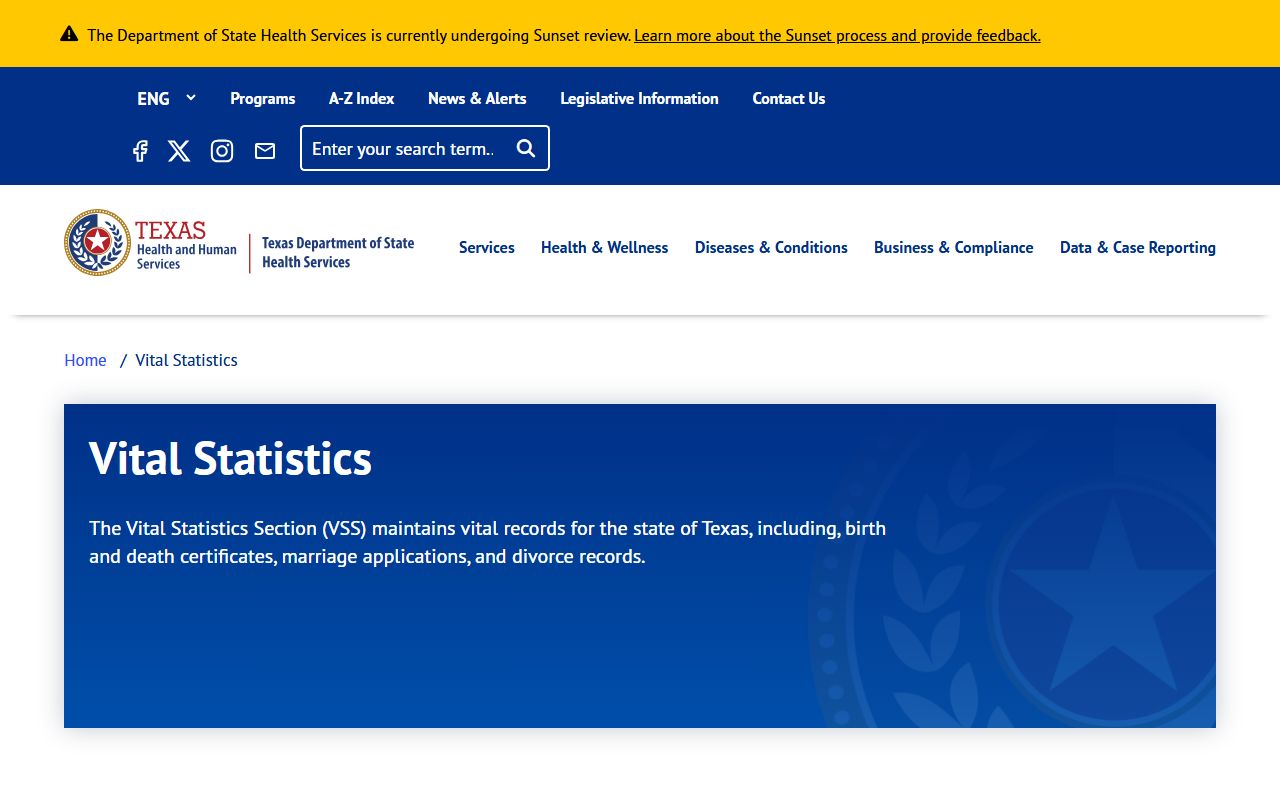
Texas.gov allows online ordering from DSHS Vital Statistics, covering Collin County records including deaths in Allen.
Who Can Access Allen Death Records
Texas law restricts recent death records. Deaths less than 25 years old are not open to the public. Only immediate family members can request a certified copy of a recent record. Immediate family means a spouse, parent, child, sibling, or grandparent of the person who died.
If you are immediate family, you must show proof of the relationship. A birth certificate linking you to the deceased, a marriage certificate, or an adoption decree all work. The clerk may ask follow-up questions, so bring more documentation rather than less.
Legal representatives can also access records. If you are an attorney handling an estate or a court-appointed administrator, bring your legal authority documents. The clerk needs to see that you are acting in an official capacity.
Records 25 years old and older are available to anyone. You do not need to explain why you want them. Public access to older records supports genealogy research and historical study.
All requesters must show a valid photo ID under Texas SB 16. Accepted IDs are listed at dshs.texas.gov. A Texas driver's license, state-issued ID, or U.S. passport all qualify. Foreign passports are also generally accepted.
Fees for Collin County Death Certificates
The Collin County Clerk charges $21 for the first certified copy and $4 for each additional copy ordered at the same time. These fees are set by state law and apply across Texas county clerk offices.
If you order through DSHS, the fee is $20 for the first certified copy and $3 for each additional copy. DSHS also offers an expedited option at $25 if you need the copy quickly.
The clerk office accepts cash, check, and money order. Some locations accept credit cards. Call 972-548-4185 for the McKinney office or 972-881-3025 for the Plano location to confirm what payment types they currently accept before your visit.
Online orders through Texas.gov or VitalChek accept credit and debit cards. These services may add a small convenience fee on top of the state fee. Review the total before you submit the order.
Texas Vital Records Law
Texas Health and Safety Code Chapter 191 is the main law covering death records. It sets rules for who must file a death certificate, how records are stored, and who can get a copy. The full text is at statutes.capitol.texas.gov.
When someone dies in Allen, the attending physician or a medical examiner certifies the cause of death. The funeral home then files the death certificate with the local registrar. The Collin County Clerk acts as the county-level registrar for all Collin County deaths. That record is then forwarded to the DSHS TxEVER system, which is the Texas Electronic Vital Events Registrar.
For deaths that require an inquest, such as sudden or unexplained deaths, Texas Code of Criminal Procedure Chapter 49 governs the process. That statute is at statutes.capitol.texas.gov. Collin County has its own justice of the peace courts that handle local inquests.
Fee rules for vital records are set out in Texas Administrative Code 25 TAC 181.31, available at texreg.sos.state.tx.us.
Historical Records and Genealogy
Collin County death records go back to 1903 when statewide registration began. Earlier records may exist in church and cemetery archives. Allen was a small farming community for much of its early history, so records from the late 1800s through early 1900s may be sparse. Growth accelerated in the 1970s and 1980s.
FamilySearch has a Texas death records collection online at familysearch.org. It is free to use and covers a wide range of years. Search by name to find a record, then contact the county clerk to order an official certified copy.
Ancestry.com holds digitized Texas vital records at ancestry.com. A subscription is needed for full access. Many Collin County public library branches offer free Ancestry access to cardholders.
The Texas State Library and Archives Commission (TSLAC) maintains a genealogy collection described at tsl.texas.gov. They have indexes and microfilm for many Texas vital records, including early Collin County filings. Remote research requests are available for people who cannot visit in person.
For older cemetery records in the Allen area, the Collin County Historical Society and local funeral homes may have logs that predate formal state registration. These are informal sources but useful as a starting point when official records are not available.
Nearby Cities
Other North Texas cities with death records pages include Plano, Frisco, McKinney, Richardson, and Dallas.
County Resources
For county-level records, see the Collin County records page.